
What is a Story System?
How one idea becomes many touchpoints and why most Namibian campaigns skip the most important step.
There is a question worth asking about almost every campaign running in Namibia right now:
If you removed the logo, would you still know whose brand it is?
In most cases, the honest answer is no.
Not because the creative isn't good. Not because the production is poor. Most times, it’s because the campaign was built as a collection of individual ideas rather than a coherent system of story. Each touchpoint invented itself. The billboard doesn't know the radio ad exists. The social content is living in a completely different world. And the consumer, who encounters all of it in fragments, is left with nothing to hold onto.
This is the problem a Story System solves.

A campaign is a burst. A story system is the architecture behind it.
A story system is the deliberate structure that connects a single brand truth to every touchpoint a consumer will ever encounter, from the biggest TV spot to the smallest social caption. It is not a campaign idea. It is the logic that makes every campaign idea feel like it belongs to the same world.
Think of it like a building. A campaign is what people see from the street - the facade, the windows, the signage. A story system is the foundation, the load-bearing walls, the blueprint that ensures none of it collapses into itself. You can change the paint, knock out a wall, add a floor, but the structural logic stays consistent. That consistency is what builds a brand over time.
Without it, you are just spending money and not building anything.
The goal is not to say something loudly. The goal is to say the same thing, everywhere, until people believe it.

It starts with one true thing
At the centre of every story system is a core brand truth, a single, specific, honest idea about who this brand is and what it stands for.
Most Namibian briefs skip this. They list features, describe the target audience, set a tone of voice, and then hand it to a creative team to come up with something. The result is a campaign built on tactics rather than truth. It might be clever. It might even win an award. But it doesn't accumulate in the consumer's mind because there is nothing underneath it to accumulate around.
A core brand truth sounds like: "We believe Namibians deserve to be seen in their full complexity, not reduced to a demographic." Or: "This product exists because hard work should taste like something." It is specific enough to exclude things. It has a point of view. And critically, it is something that every single piece of communication can honestly reflect — even if it reflects it differently across different channels.
From that truth, you build narrative pillars:
The emotional dimension (how the brand makes people feel), the rational dimension (what the brand does or proves), and the cultural dimension (where the brand fits in the world people actually live in). These pillars are lenses through which the same truth is expressed.

Each channel does a different job but tells the same story
Once you have a core truth and your pillars, your channel strategy stops being about reach and frequency and starts being about role. Each touchpoint has a specific job to do within the system.
Television and video carry the big emotional moment — the feeling of the brand at its most expansive. Radio does the intimate, everyday version of that same feeling, in the voice and language of the people actually listening. Outdoor strips the idea down to its most essential form: one thought, communicated in three seconds to someone driving at 120km/h. Social media opens a conversation around the idea, inviting people in rather than broadcasting at them. Activation brings the brand world into physical space. Digital provides the utility and the proof.
The content changes. The idea does not.
This also means not regurgitating the same content on every platform.
This is the through-line. The invisible thread that runs through every single touchpoint and makes the whole greater than the sum of its parts. It is not a consistent visual identity (though that helps). It is a consistent way of seeing the world that the brand holds regardless of format, channel, or budget.
Consumers don't experience a brand in one sitting.
They catch a billboard on the B1, hear a radio ad on the way to work, scroll past a post at lunch. If each of those moments tells a different story,
the brand never builds in their mind.
What happens when the campaign doesn't serve the brand: the Oshikandela case



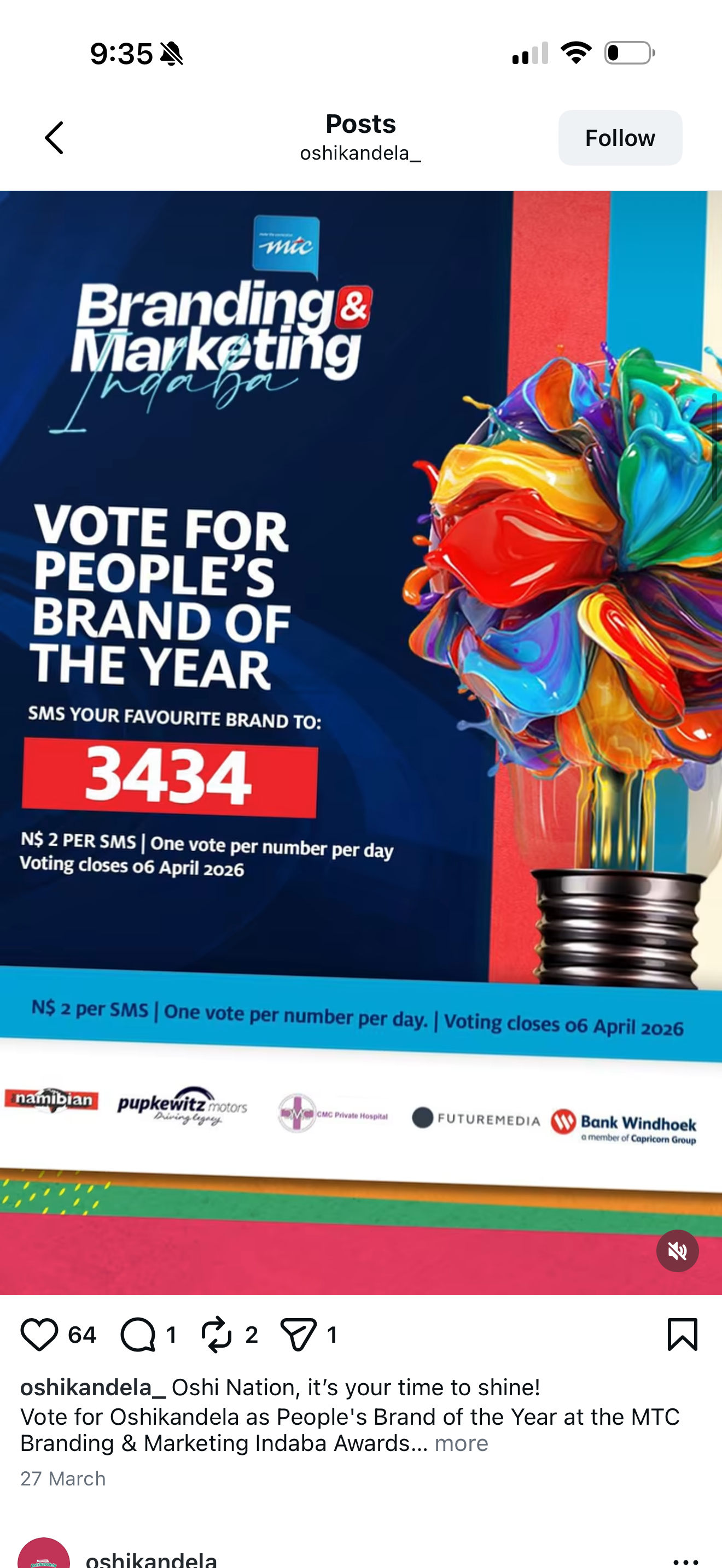
To understand what a story system misalignment looks like in practice, consider the "My OshiTime" campaign for Oshikandela, the popular Namibian drinking yogurt.
On the surface, it ticks familiar boxes: a vernacular hook, a personal ownership framing, energy and relatability. But there is a foundational problem that no amount of production quality can fix.
In Oshiwambo, "Oshi" is not a word. It is a grammatical prefix — a noun class marker that attaches to a root to form a complete word. In "Oshikandela", the meaningful unit is "kandela" (the milk or yogurt). "Oshi" is the structural vehicle it rides in, equivalent in function to the articles "a" or "the" in English.
By isolating "Oshi" and building a campaign identity around it — "My OshiTime" — the campaign has inadvertently built its emotional core around a grammatical particle. Translated honestly, the slogan reads: "My The-Time." It means nothing. And more critically, it sounds like nothing anyone would ever actually say. Nobody in Namibia walks into a moment and declares it their "OshiTime". The phrase does not exist in natural speech, which means the campaign is asking consumers to adopt an expression the culture never produced.
This is not a creative failure — it is a strategic one. In fact, the creative roll-out was spectacular, the visual branding of the campaign, the involvement of DJ Castro, the quality of the content produced. All good.
The error happened upstream, before a single word was written, in the moment when the team asked "what's a catchy campaign idea?" instead of "what does Oshikandela genuinely mean to the people who drink it?"
The brand already owns something powerful. Oshikandela is a warm, familiar, culturally embedded name. It evokes the product, the ritual, the taste, the memory. That is the asset. A story system built on a genuine brand truth — what this drink represents in the daily lives of Namibians — would have generated a campaign that grew out of the brand rather than bending the brand to fit the campaign.
Instead, the strongest thing the brand owned was quietly dismantled to make a slogan work.

The real cost of campaigns without a system
The most visible symptom of a missing story system is inconsistency: campaigns that look and feel different every year, brands that seem to be in an identity crisis even when they are not, audiences that cannot describe what a brand stands for even after years of exposure.
But the less visible cost is cumulative. Every campaign that starts from scratch is not just a missed opportunity to build on what came before — it is an active reset. The consumer has to relearn the brand. The emotional equity from the previous campaign is abandoned. The next agency, or the next brief, starts the clock again.
Over a five-year period, a brand with a strong story system and consistent through-line will have built something that functions almost like a cultural institution — a recognisable way of seeing the world that people associate with that brand without being told to. Over the same five-year period, a brand running disconnected campaigns will have spent considerably more money to achieve considerably less.
The system is not a constraint on creativity. It is the opposite. When you know what the brand truly stands for, creative teams have a launchpad rather than a blank page. The best work comes from having something real to push against.

A simple test
Before your next campaign goes into production, apply this test to every single touchpoint:
Remove the logo. Remove the product shot. Remove any explicit brand mention. Does what remains - the tone, the world, the feeling, the way it speaks - still unmistakably belong to this brand and no other?
If yes, you have a through-line. If no, you have a collection of ideas that happen to share a budget.
The goal of a story system is to make that test easy to pass — not through rigid templates or restrictive guidelines, but through a deep, shared understanding of what this brand is and what it believes. When that understanding exists, it shows up in everything. When it doesn't, nothing you spend will make it appear.
This post is part of an ongoing series on brand strategy and communication in the Namibian market.